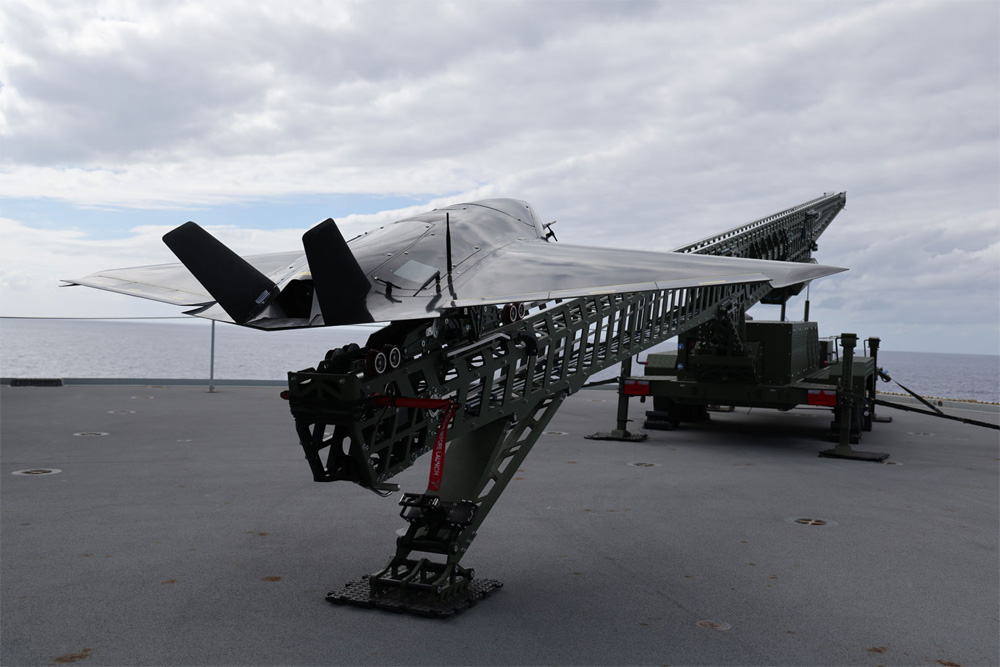
The UK’s Royal Navy revealed it conducted its first launches of unnamed strike drones from the deck of HMS Queen Elizabeth last month. It called the tests a major step in the plans to transform the Royal Navy and how Britain fights at sea.
The landmark North Atlantic trials took place in mid-October using British-made Nyan Maritime one-way drones, manufactured in Wiltshire by Callen-Lenz. According to the statement, they demonstrated how autonomous strike systems could operate alongside F-35B stealth jets. Working with experts from across the Armed Forces and industry, the Royal Navy reports it conducted a number of flights from HMS Queen Elizabeth, following the drone's first launch at sea from the experimentation ship XV Patrick Blackett earlier this year.
At the same time, the carrier also hosted Heavy Lift Challenge 3, which saw a Tekever AR5 fixed-wing uncrewed aircraft operate from a carrier for the first time. With a 7-meter (23-foot) wingspan and capacity to carry 80kg, the AR5 can support both logistics and operational missions. The Royal Navy reports the trials demonstrated how drones used for intelligence, surveillance, target acquisition and reconnaissance could operate alongside strike systems as part of a more integrated fighting force.
Uncrewed aircraft were also part of the demonstration (Royal Navy)
“These trials give us the evidence and confidence to decide how uncrewed systems can work alongside crewed aircraft,” commented Lieutenant Commander David Burton, trials sponsor for Navy Capability. “The lessons will help us build a hybrid Navy that gives commanders greater choice and ensures our carriers remain at the cutting edge of naval warfare.”
The Royal Navy reported that the trials marked another step towards its high-tech approach to fighting in the air, from an aircraft carrier, known as the “hybrid carrier air wing.” The approach brings together crewed aircraft and drones to increase the carrier’s reach, lethality, and flexibility, while keeping personnel further away from danger.
The trials developed understanding of how uncrewed strike systems could contribute to future Carrier Strike operations and wider Defence activity. They were also part of the government's plan to modernize the Armed Forces.
Launches were conducted for the first time from the carrier's flight deck (Royal Navy)
The Ministry of Defence highlights that the Defence Investment Plan provides over £5 billion for autonomous systems by 2030, the largest ever drone investment in defence. Among the elements are almost £250 million for Project Pantheon, which calls for developing autonomous systems to build a hybrid carrier air wing, and for trials of jet-powered drones to work alongside the F-35B force. In addition, it plans to invest at least £1.3 billion for a hybrid fleet of crewed and uncrewed ships, with the first large autonomous vessels due in service by 2030, and at least £210 million for low-cost, long-range one-way attack drones for the Navy, Army, and RAF.
The plan sets out that the Queen Elizabeth class carriers will use uncrewed systems to strengthen the F-35B force, creating a hybrid carrier air wing.