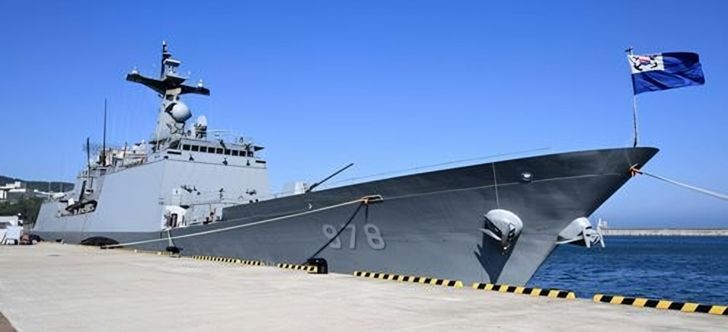
South Korea's government wants to deploy naval assets somewhat closer to the Strait of Hormuz, eight months after the start of the U.S.-Iran conflict. The limited mission would not involve any surveillance of the Iranian mainland and will not enter the area of the strait itself, the country's defense ministry said.
Like all petroleum-importing nations, South Korea has a direct economic interest in seeing the two-way siege of the Strait of Hormuz come to an end. In addition to the energy-price effects of insecurity, the largest single player in the "Hormuz shuttle" tanker trade is a Korean firm, Sinokor; its vessels have been hit by likely Iranian fire at least half a dozen times since the start of the conflict.
But Korea has pledged to have no direct military involvement in the conflict, and will not be deploying troops on the ground. The new, limited mission is simply an expansion of the area of operations for an existing Gulf of Aden antipiracy patrol squadron, which consists of of one destroyer, one P-8 maritime patrol aircraft, EOD divers and a variety of unmanned systems.
If approved by South Korea's parliament, the proposal would allow the ROK Navy's "Cheonghae" antipiracy squadron to operate as far north as Duqm, Oman - about 500 nautical miles of seagoing transit away from the Strait of Hormuz.
The mission has rotated through the Gulf of Aden since 2009, when Korea first began sending warships to help fight Somali piracy and ensure the security of its shipping. It currently operates out of Salalah, Oman and Djibouti, but has not historically had reason to travel as far north as Duqm before. The new deployment area still keeps the ROK Navy's assets far away from Iranian fire and U.S. Navy interdiction operations - and any additional tasking in the areas in the line of fire would be subject to parliamentary approval.