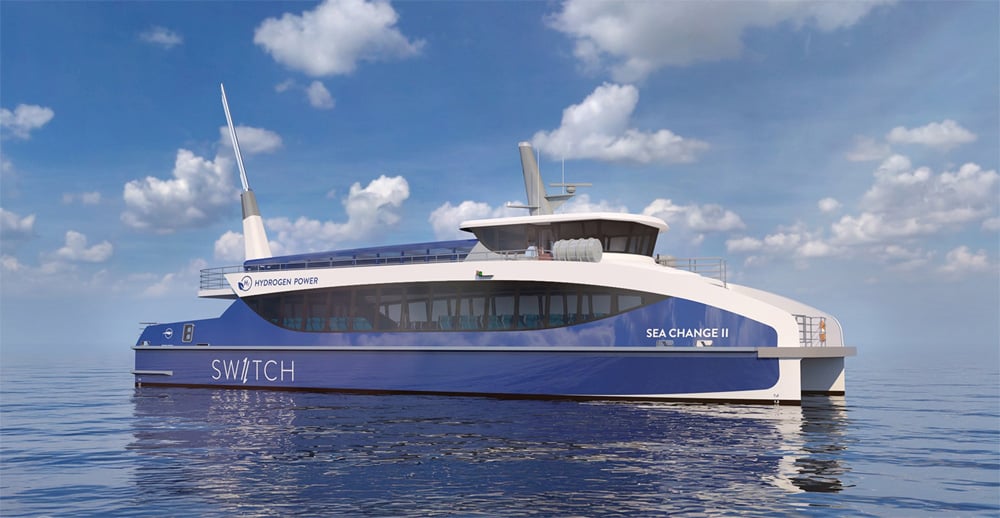
A Design Basis Agreement (DBA) was secured by Incat Crowther in partnership with SWITCH Maritime from the United States Coast Guard for a proposed 150-passenger hydrogen fuel cell-electric fast ferry platform designed to operate in New York City. The project is being called a “significant regulatory milestone,” as SWITCH, which pioneered the first hydrogen fuel cell-electric propulsion in the United States in 2024, looks to expand the commercial applications for the technology.
The companies highlighted the challenges, noting that the USCG Subchapter T regulation, the set of rules and standards that governs the design, construction, and operation of passenger vessels with a capacity of less than 150 passengers, does not currently include guidance or regulation written specifically for hydrogen fuel cell-electric propulsion and hydrogen storage. Switch, Incat Crowther, and the vessel project team worked directly with the USCG to build a regulatory framework that demonstrates sufficient equivalency in safety and risk mitigation. The International Maritime Organization (IMO) approved the Interim Guidelines for the Safety of Ships Using Hydrogen as Fuel in May 2026. These guidelines served as an important foundation for the DBA process, adding more structure while reducing time to approval.
Signing the DBA with the Coast Guard is a critical milestone in advancing the development of the SWITCH-150,” said Francisco Planells, Director of the Newbuild Program, Switch Maritime. “With the DBA in hand, Switch, our project team, and the USCG have a clear and defined framework that will inform vessel construction, commissioning, and ultimately operation.”
The program envisions a 28-meter (92-foot) ferry designed to carry 150 passengers at a cruising speed of 25 knots. It is based on Incat’s catamaran design built of aluminum and would incorporate 1576 kWh of batteries.
With 720 kilograms of stored, compressed hydrogen capacity, it will be able to run a range of routes across New York ferry networks with a full day of range. The main deck will feature comfortable seating for 150 passengers, ample luggage storage, a kiosk, three bathrooms including a wheelchair accessible bathroom, and large windows to allow passengers to enjoy the iconic views on New York’s waterways.
SWITCH-150 draws directly from the technical, regulatory, and operating framework set by Switch’s first vessel, Sea Change, a 70-foot ferry with a capacity of up to 75 passengers. Also designed by Incat Crowther, Sea Change was the first hydrogen fuel cell-electric ferry in the United States. It received its DBA from the USCG in 2020 and its Certificate of Inspection (COI) in 2024, permitting it to begin passenger service in July 2024, operating in San Francisco Bay.
“The DBA is validation of the smart engineering and safety-focused approach built into the vessel design, giving operators confidence that hydrogen fuel cell-electric propulsion can be delivered on a fast ferry of this size. With the DBA now in place, our focus moves to taking the design through detailed development and into a complete digital shipbuilding package ready for construction,” said Dan Mace, Technical Manager, Incat Crowther.
SWITCH highlights the advantages of the concept, noting that the SWITCH-150 platform is designed to align with the performance and operating specifications that ferry operators have come to expect from diesel vessels. Powered by an integrated hydrogen fuel cell-electric propulsion and hydrogen storage system, SWITCH says the vessel will have the capability to perform high-frequency, high-intensity ferry operations like an existing diesel vessel. This means parallel service speeds, a daily bunkering schedule, and no need to increase dwell time or alter service to account for vessel charging. It will not require costly and complicated shoreside charging infrastructure and power grid upgrades, instead supplied by mobile hydrogen refueling equipment. SWITCH-150, they report, can be seamlessly integrated into an ongoing ferry operation, rather than requiring scheduling changes or a system-wide reorientation, as would be required for a comparably specified battery-electric vessel.
The first SWITCH-150 is intended to operate in New York City, based at the Brooklyn Navy Yard. The development of New York’s first hydrogen fuel cell electric ferry is supported by a $2 million grant from the New York State Energy Research and Development Authority (NYSERDA).